Every real estate website I build gets the same handful of things. I assumed everybody else’s did too, so this month I checked 30 agent websites around Knoxville. Not one had a button that lets you text the agent.
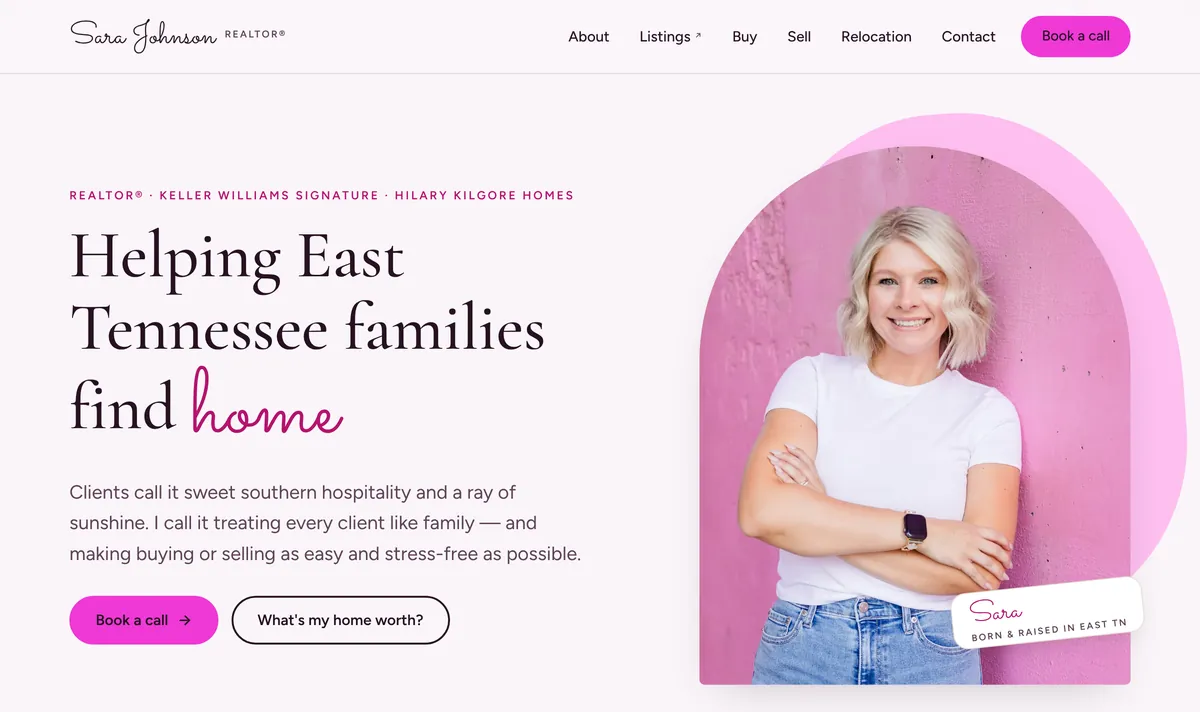
Zero for thirty. Here are that and five other things most of them left out, shown on a site that has all six: sarasellsknoxville.com, which I built in September for Sara Johnson, a REALTOR® with Keller Williams Signature. Full disclosure: Sara is on my wife Hilary’s team, Hilary Kilgore Homes, so a bad website would have come up at dinner.
How I checked
On October 13 I looked at 30 agent websites in Knox, Blount, Loudon and Anderson counties: 16 solo agents and 14 teams or small brokerages. Some came from earlier research. The rest came from Google searches like “Maryville TN realtor,” which means those sites already rank. If anything, that flatters the sample.
For each site I read the home page, its llms.txt file, and up to two inner pages, usually the seller page and the buyer page. I loaded the home pages in a real browser wherever the site allowed it. If I couldn’t see something, I didn’t count it, so a great FAQ buried on page nine got missed. I’m not naming anybody. Most of these sites look nice. This is about what’s missing, not who’s missing it.
A button that texts the agent
None of the 30 had one. Most had a phone number you could tap, which dials. Not one had a link that opens a text message with the agent’s number already filled in.
It’s the same link as a phone number, with sms: where tel: would be:
<a href="sms:+18655550142">
  Text me
</a>
Some people will call a stranger. Plenty would rather text one, especially with a question they’re afraid is dumb. Sara has a Text Sara button on five of her six pages, right next to Book a call.
Answers to the questions people actually ask
Two of the 30 had a real FAQ, meaning three or more questions with answers, on the pages I checked. One of those two lives on the brokerage’s website, not the agent’s.
Sara’s relocation guide answers six: how far Knoxville is from the Smokies, whether Tennessee taxes wages, whether you need to visit before you buy, what the weather is like, whether she can sell your house in another state, and which areas she covers. The out-of-state question gets an honest answer. She can’t list a home outside Tennessee, so she says that, then offers to find you an agent where you are and line up the timing on both ends.
This is the part AI assistants are looking for. When somebody asks one whether they need to visit Knoxville before buying, the page most likely to get quoted is the one that asks that exact question and answers it in two sentences. I wrote more about that in SEO vs. AEO.
Towns with something said about them
Eighteen of the 30 listed the towns they serve as names: a menu, a row of photo tiles, a line of text. Six didn’t name anything smaller than Knoxville or “East Tennessee.” Only five said anything about a place, and one of those only said it about Knoxville.
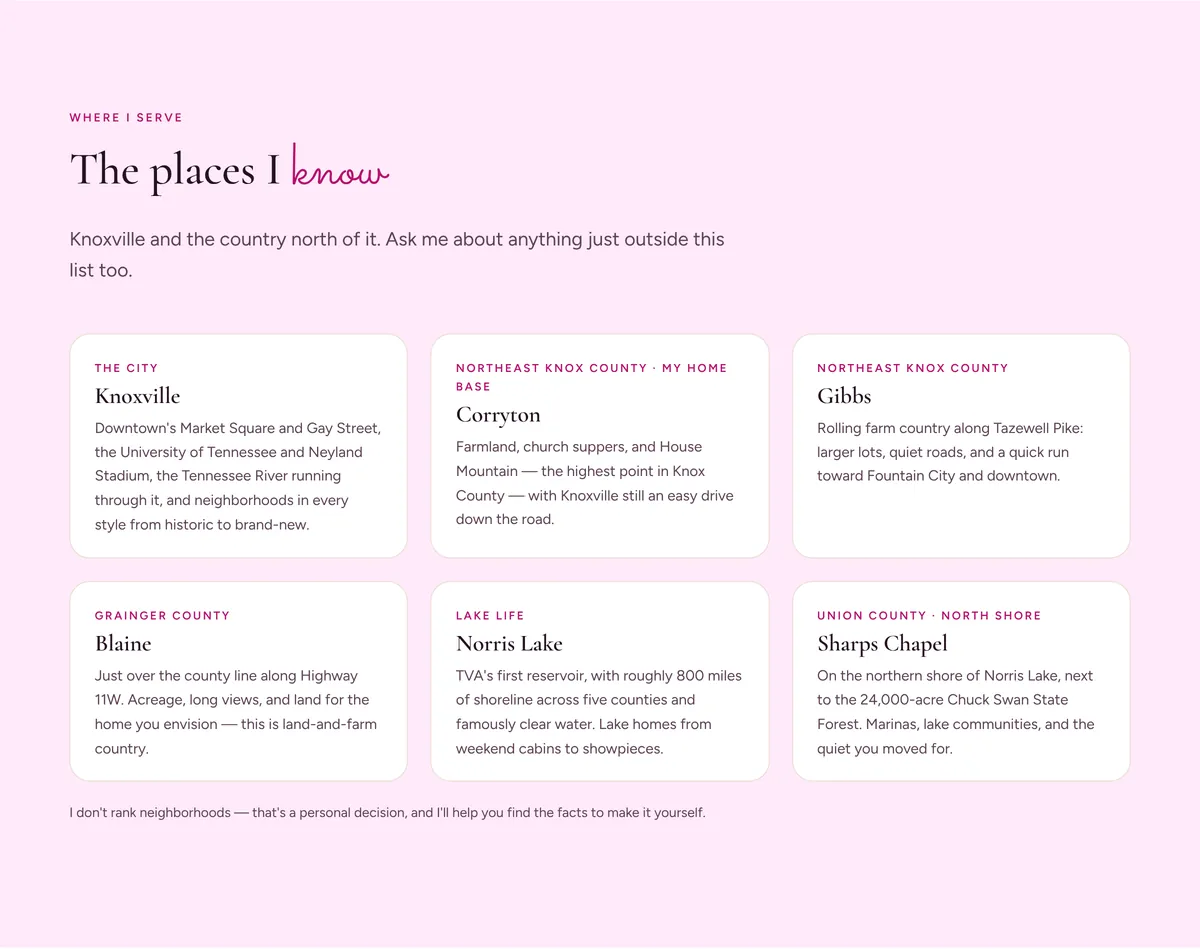
A name on a menu tells Google you’ve heard of Corryton. A sentence tells a family moving from Ohio whether they’d want to live there. Sara serves six places, and each gets its county and a few lines: farm country along Tazewell Pike in Gibbs, acreage off Highway 11W in Blaine, marinas and a state forest next door in Sharps Chapel.
Under all six is one more line: she doesn’t rank neighborhoods. Agents have to be careful about steering buyers toward or away from an area, so she says plainly that she won’t, and that she’ll help you find the facts to decide for yourself. Saying what you won’t do is information too.
The whole process, buying and selling
Seven of the 30 laid out the buying or selling process as actual steps. Two did both.
Sara’s buyer page goes from first call to keys in seven steps. Her seller page goes from “I think we want to sell” to closing in six. The relocation guide adds five more for a long-distance move, from the first video call to after you get here.
A first-time buyer doesn’t know what happens after the offer. A seller doesn’t know when the photographer comes. Writing it down answers the question before they have to ask it, and it gives an AI assistant something accurate to work from when someone asks how buying a house around here works.
The fine print, in words
I checked each home page for four things: the agent’s license number, the brokerage’s name, the brokerage’s office phone, and the words “Equal Housing Opportunity.” Most had the brokerage (24 of 30) and an office phone (22). Nine had a labeled license number. Eight had Equal Housing in words a machine can read. Five more had only the logo, as a picture with no text or the wrong text. One is labeled “house.”
Two of the 30 had all four.
This is what tells a stranger you’re licensed and real. On Sara’s site it’s one line at the bottom of every page, in plain text: her name, her Tennessee license number, Keller Williams Signature, the office address and phone, and Equal Housing Opportunity. It’s the most boring line on her site, which is fine. Fine print isn’t supposed to be fun. It’s supposed to be there.
An llms.txt somebody actually read
An llms.txt is a plain-text summary of a website written for AI tools. Thirteen of the 30 had one, which surprised me. Then I read them. As far as I can tell, the website platform generated every one automatically. One is titled “Mysite.” Another runs 144 KB and is mostly a list of blog posts.
I’ll be straight with you: I don’t count on llms.txt doing much yet, for the reasons in the SEO vs. AEO post. But if a robot is going to read a summary of your business, it shouldn’t introduce you as Mysite. Sara’s is written by hand from her own pages: who she is, her license, her brokerage and team, where she works, what she will and won’t do, and how to reach her.
What her site is still missing
Reviews. Sara is a new agent, and I don’t make reviews up. When her clients write them, they go up, with permission.
None of the rest is hard. Nobody asks for it, which is why it gets skipped. I don’t skip it. I’m the guy who checked 30 websites for a text button.
Quick answers
What do most real estate agent websites leave out?
In a check of 30 Knoxville-area agent websites in October 2026, none had a tap-to-text link, two had a real FAQ, five said anything about the towns they serve, seven laid out the buying or selling process in steps, and two showed a license number, brokerage, office phone and Equal Housing Opportunity statement together on the home page.
How do you add a text-message button to a website?
Use a link that starts with sms: instead of tel:, followed by the phone number. On a phone, tapping it opens a new text message to that number. On a computer it may open a messaging app or do nothing, so keep the phone number visible as well.
Does a real estate website need an llms.txt file?
Probably not yet. Server-log data published in mid-2026 showed almost no AI crawler requests for llms.txt files, and Google says the file has no effect on rankings. It costs nothing to have one, though, so if your website platform made one for you, read it and make sure it describes you correctly.
Sources: 30 Knoxville-area real estate agent websites, checked October 13, 2026 (home page, llms.txt and up to two inner pages each); sarasellsknoxville.com, checked and photographed October 13, 2026; Ahrefs log data as reported by PPC Land, July 2026.