Every few weeks somebody asks me what AEO is, and I watch their eyes glaze over somewhere around the words “structured data.” Fair enough. So here is the version with an actual website in it.
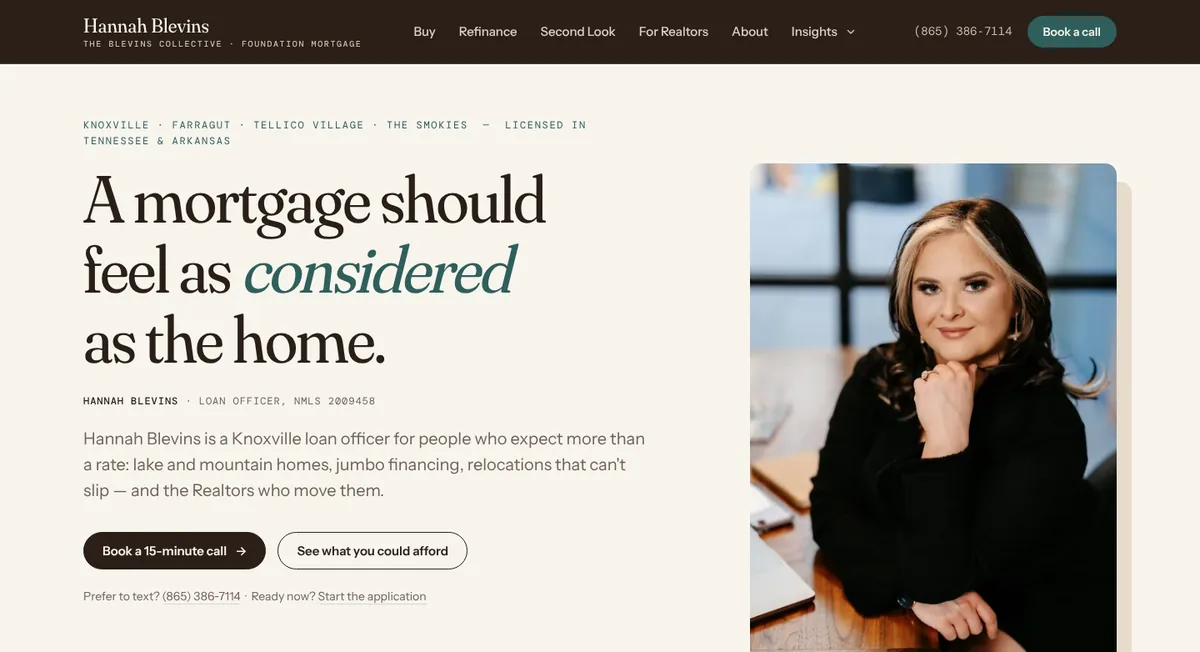
The website belongs to my friend Hannah Blevins, a loan officer at Foundation Mortgage here in Knoxville. Her old site was on Squarespace, and it looked good. Black and cream, gold headlines, real photos. The problem wasn’t how it looked. The problem was that it never told anyone, or anything, what it was. I rebuilt it, and the new version went live this month at theblevinscollective.com.
The thirty-second version
SEO, search engine optimization, is making a page easy for Google to find, understand, and rank in a list of links. AEO, answer engine optimization, is making the same information easy for AI assistants like ChatGPT, Claude, Perplexity, and Google’s AI Overviews to understand, trust, and quote when somebody asks a question.
SEO gets you a spot in the list. AEO gets you a mention in the answer. Same foundation, different finish line.
Before: a nice site that only said its own name
When I looked at Hannah’s old site in early September, the title on the home page, the line Google shows as the blue link, was “The Blevins Collective.” That’s it. No “mortgage,” no “Knoxville,” no hint that she makes loans. The meta description, the short summary under the link, was empty. The image that shows up when you share the site was a file named “Untitled design.jpg.” There was no structured data, no FAQ, and no blog, and the loan types page was eight generic definitions you could find on any bank’s site.
In fairness to whoever built it: my first website almost certainly had a file named “Untitled” in it somewhere. Probably several.
| What | Before (September) | After (October) |
|---|---|---|
| Home page title | The Blevins Collective | Hannah Blevins | Knoxville Mortgage Loan Officer · Lake, Mountain & Jumbo Home Loans |
| Meta description | Empty | Who she is, her NMLS number, her employer, what she specializes in, and where she’s licensed |
| Structured data | None | Hannah, her team, and her employer, linked together, with both NMLS numbers |
| Pages for specific loans | One page of eight generic definitions | Separate pages for lake and mountain homes, relocating to Knoxville, first homes, and refinancing |
| FAQ | None | 30 Tennessee mortgage answers, most with sources, checked September 10, 2026 |
| Summary for AI tools | None | An llms.txt file in plain English |
The SEO part: tell Google what the page is
None of this is magic. It’s labeling. Anyone who has ever traced an unlabeled cable through a server rack knows the principle: if it isn’t labeled, nobody can find it, and eventually somebody unplugs the wrong thing.
Titles. A page titled “The Blevins Collective” can only win searches for “The Blevins Collective,” which means it only reaches people who already know her. The new home title names her, her job, her town, and the three kinds of loans she most wants to write. Every other page gets its own title too, like “Lake & Mountain Home Loans in East Tennessee” or “Tennessee Mortgage FAQ for Knoxville Buyers.”
Descriptions. When a page has no description, Google writes one for you by grabbing whatever text it finds. Sometimes that works. Sometimes it’s your cookie banner. Now every page says what it’s for in a sentence or two.
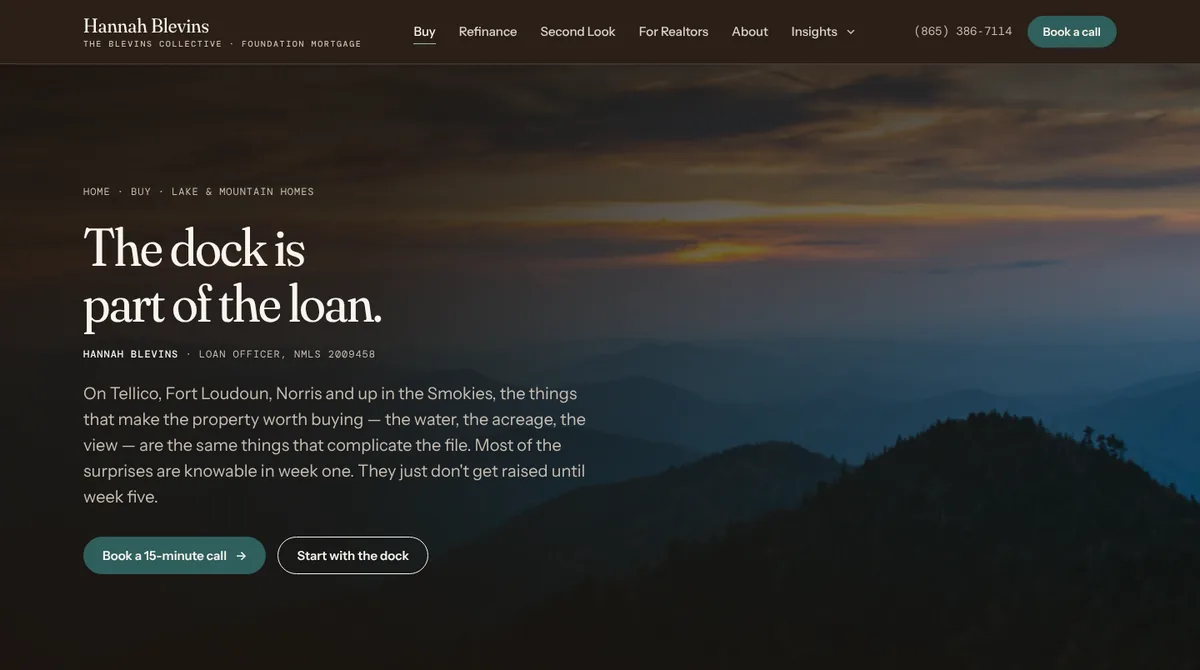
One page per question people actually ask. Nobody searches “loan types.” People search things like financing a house on Tellico Lake, or what a TVA dock permit does to a sale. So the lake and mountain page talks about Tellico, Fort Loudoun, Norris, the Smokies, second-home rules, and dock permits, because that’s what her buyers type into the box.
The boring plumbing. A sitemap listing all 13 pages, submitted to Google Search Console and Bing. Plain HTML that loads fast on a phone. A canonical address on every page so Google doesn’t count the same page twice. Nobody will ever compliment any of this, which is how you know it’s working.
The AEO part: give the robots something worth quoting
An AI assistant answering “who’s a good loan officer for a lake house near Knoxville?” isn’t reading a list of links the way you do. It’s pulling facts from sources it can understand and cross-checking them against each other. So AEO comes down to three things: be unambiguous, answer real questions directly, and say the same thing everywhere.
Be unambiguous. Structured data is a block of code that tells machines, in their own language, exactly who and what a page is about. Hannah’s home page now carries one that says she is a loan officer with NMLS number 2009458, that she works for Foundation Mortgage Company (NMLS 1387311), where the office is, which towns and states she serves, and which LinkedIn, Instagram, and Facebook profiles are actually hers. A trimmed piece of it looks like this:
{
  "@type": "Person",
  "name": "Hannah Blevins",
  "jobTitle": "Loan Officer",
  "identifier": {
    "propertyID": "NMLS",
    "value": "2009458"
  },
  "worksFor": { "@id": "#foundation" },
  "sameAs": [
    "linkedin.com/in/hannah-blevins-…",
    "instagram.com/mortgage_queen_…",
    "…"
  ]
}
That lives behind the home page, and every other page points back to it. A person reading the site never sees it. A machine reading the site sees almost nothing else.
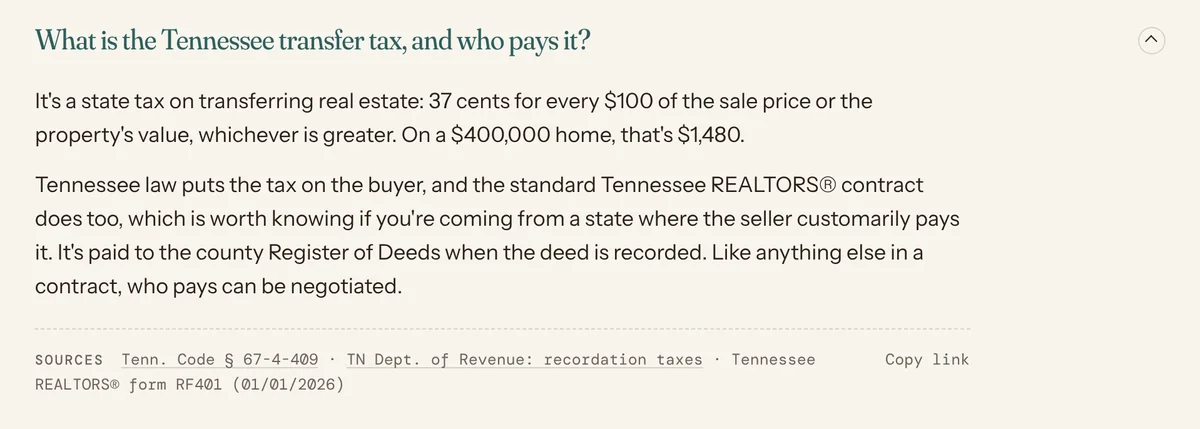
Answer real questions directly. Her mortgage FAQ has 30 questions Tennessee buyers actually ask, like who pays the transfer tax, whether you need an attorney to close, and what the Knox County reappraisal does to your escrow. Each answer starts with the answer and has its own link, most list their sources underneath, and the page says when it was all last checked. That is exactly the shape an assistant can lift, check, and credit.
Say the same thing everywhere. Her name, both NMLS numbers, and the office address match on every page, in the footer and in the structured data. Assistants cross-check. When sources disagree, the safest move for a machine is to mention nobody.
The llms.txt file. This is a plain-text summary of a site written for AI tools, proposed in 2024. I’ll be straight with you: in mid-2026, server-log data from Ahrefs showed 97 percent of llms.txt files got zero requests in a month, and Google says the file doesn’t affect rankings. I added one anyway. It took ten minutes, it hurts nothing, and if the robots ever start reading it, hers is ready.
What happens now, and what doesn’t
The new site has been live for days, not months. Google has to recrawl it and decide where it belongs, and that takes weeks. AI assistants are even less predictable, because nobody outside those companies controls what the models say.
So here is the honest version. I can make a site the easiest thing on the internet for a machine to understand and quote. I can’t make the machine call her, and anyone who promises you a specific assistant will name you on a specific day is guessing. For a local business, a well-kept Google Business Profile matters as much as anything on this page, and it lives outside the website entirely.
Quick answers
What is the difference between SEO and AEO?
SEO makes a page easy for a search engine to find, understand and rank in a list of links. AEO makes the same information easy for AI assistants such as ChatGPT, Claude, Perplexity and Google’s AI Overviews to understand, trust and quote in an answer. SEO wins a position; AEO wins a mention.
Does AEO replace SEO?
No. AEO is built on top of SEO. An assistant can’t quote a page it can’t find or doesn’t understand, so the titles, descriptions, speed and structure that SEO needs come first.
Does an llms.txt file help?
Probably not yet. Server-log data published in mid-2026 showed almost no AI crawler requests for llms.txt files, and Google says the file has no effect on rankings. It costs nothing to add, so I add one, but I don’t count on it.
So that’s SEO and AEO. One gets you into the list, the other gets you into the answer, and both start with the same unglamorous job: saying clearly who you are, what you do, and where. Hannah’s old site said her team’s name very clearly. It just didn’t say anything else.
If you want the longer version of how I do this for agents and lenders, it’s on the AEO page, and Hannah’s site is on the work page. The next post is about cars. You’ve earned it.
Sources: Hannah’s old Squarespace site as recorded in my September 5, 2026 audit notes; the live theblevinscollective.com, checked October 10, 2026, with screenshots taken October 11, 2026; Ahrefs log data as reported by PPC Land, July 2026.